Product
The company works across adtech and mobile apps: RTB-driven ad networks on one side, and VPN apps, utilities, and productivity mini apps on the other.
Responsibilities
-
My first task was to revive the RTB business: from improving communication with existing partners and bringing in new ones to fixing auctions, anti-fraud, and the product itself from both technical and product sides.
-
The second task was to take over internal processes and tools, remove unnecessary work, and help teams become more productive under a limited budget.
RTB Results
- Audited RTB product line and created a structured growth roadmap covering monetization, infrastructure, and operational bottlenecks
- Optimized traffic routing, auction logic, and partner prioritization, increasing auction win rate by ~12% and reducing traffic acquisition costs by ~18%
- Improved traffic quality control and margin monitoring, reducing low-quality traffic spend and recovering up to 10–15% of previously lost margin
- Built monitoring systems that prevented up to 30% revenue loss and reduced incident detection time from hours to minutes
- Systematized partner management: added 20 partners to integration queue, generated 50+ new leads, and improved partner processing visibility through internal tooling
Internal Systems Results
- Developed internal RAG-based AI knowledge assistant covering product, support, and operational documentation, reducing repetitive internal requests by ~60% and accelerating onboarding for new employees
- Built AI-powered analytics assistant enabling employees to query business metrics in natural language and automatically generate dashboards and reports, reducing reporting turnaround from hours to seconds and eliminating the need for dedicated analysts in multiple teams
- AI Content Factory
- Automated cross-department workflows between finance, support, and operations teams, significantly reducing manual coordination overhead and improving process transparency
- Reorganized fragmented finance, support, and sales operations into scalable workflows with clear ownership and reporting structure
- Laid the foundation for internal automation and back-office tooling, reducing operational overhead and enabling the team to scale without proportional hiring growth
Responsibilities
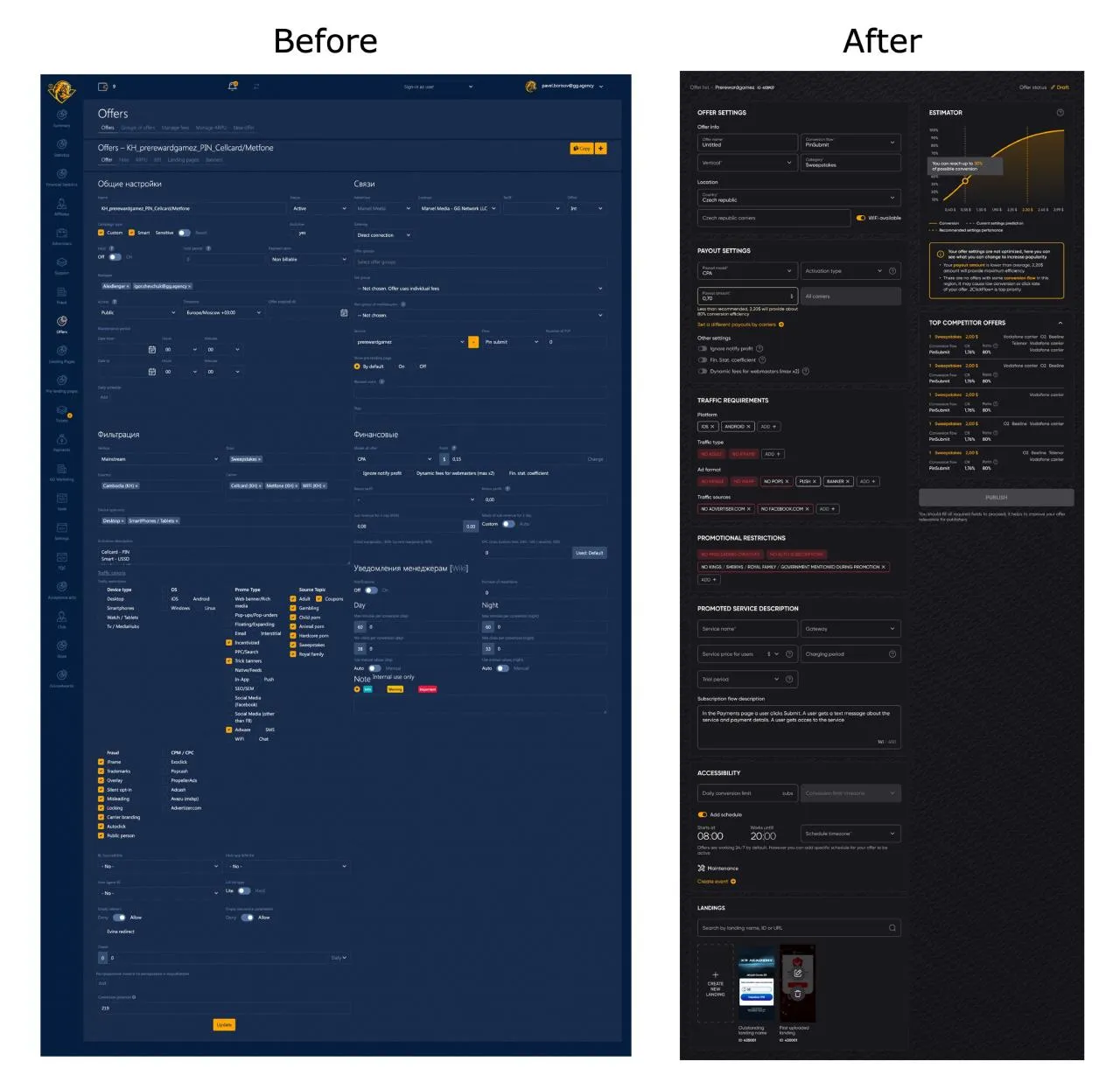
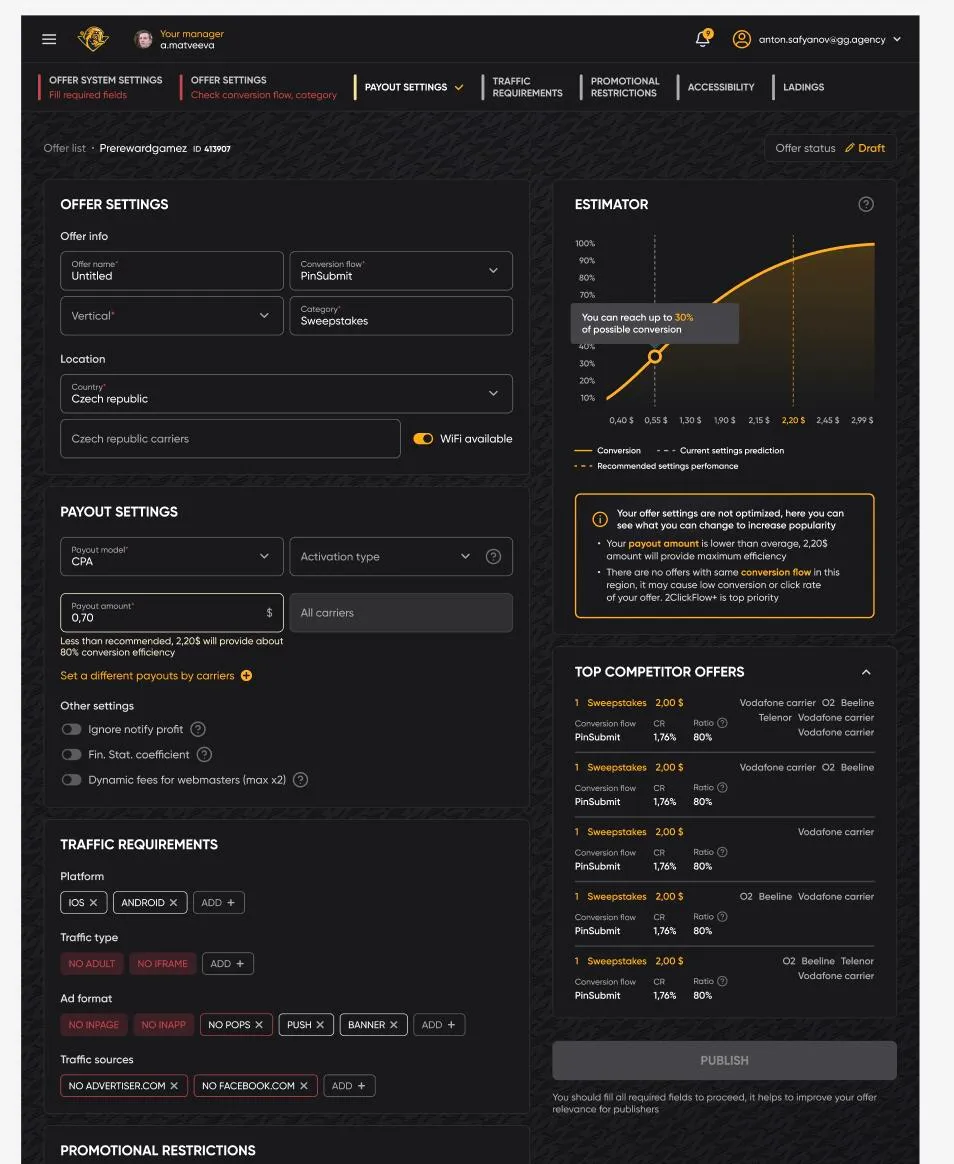
Built a self-service advertising platform for advertisers from scratch, with the goal of moving most partners to self-service while keeping only the largest accounts under manual management.
Also introduced new back-office tools to improve the work of account managers and other teams working with, or depending on, the sales team and its clients.
Results
- Launched advertiser self-service platform, fully replacing legacy manual processes
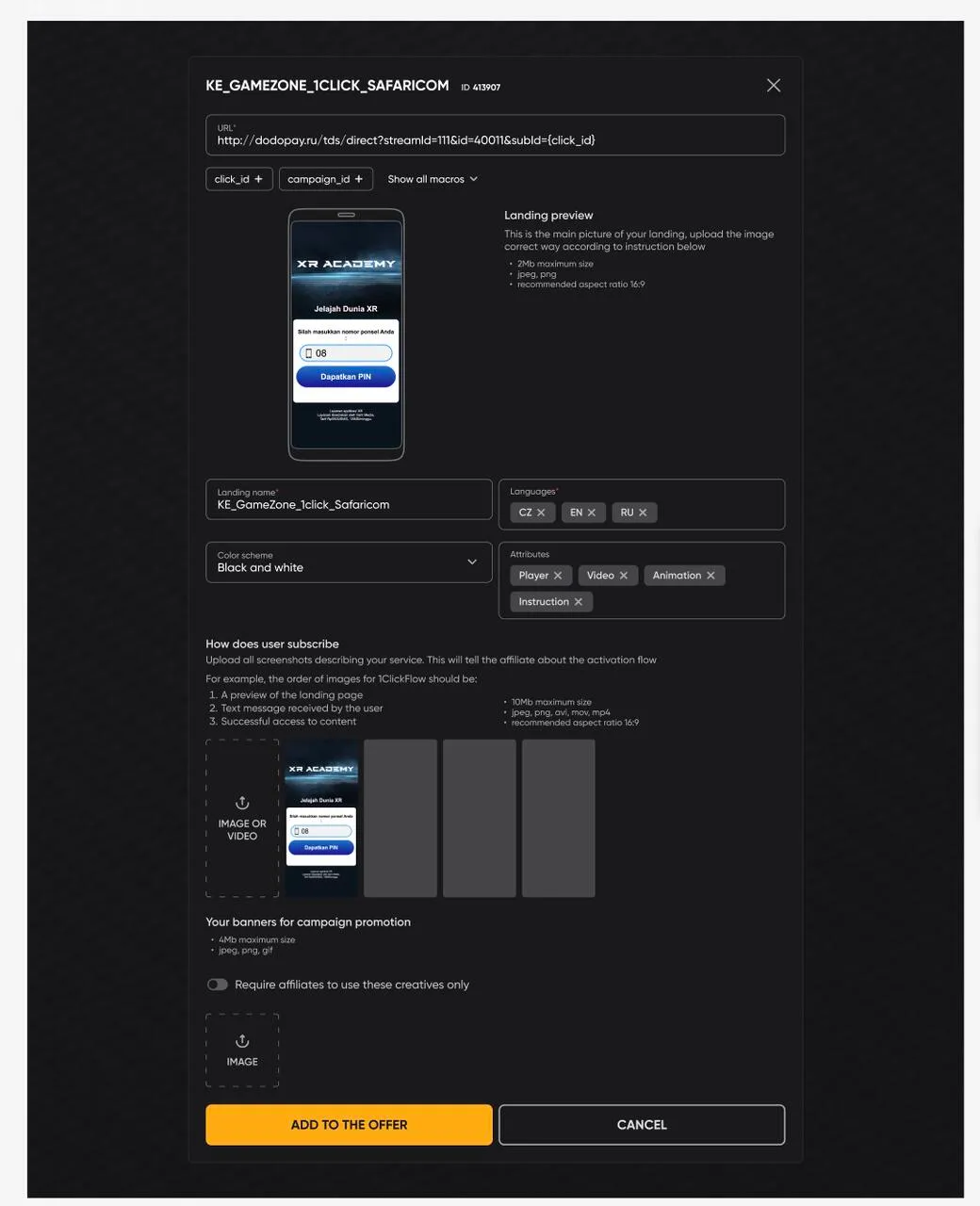
- Migrated 100% of new clients from manual verification to automated onboarding and offer publishing
- Grew offers by 2.5x and revenue by 1.3x for new registrations
- Developed back office with analytics, traffic quality insights, client profiles, and monitoring tools
- Cut IT manual workload, enabling focus on product backlog
Product
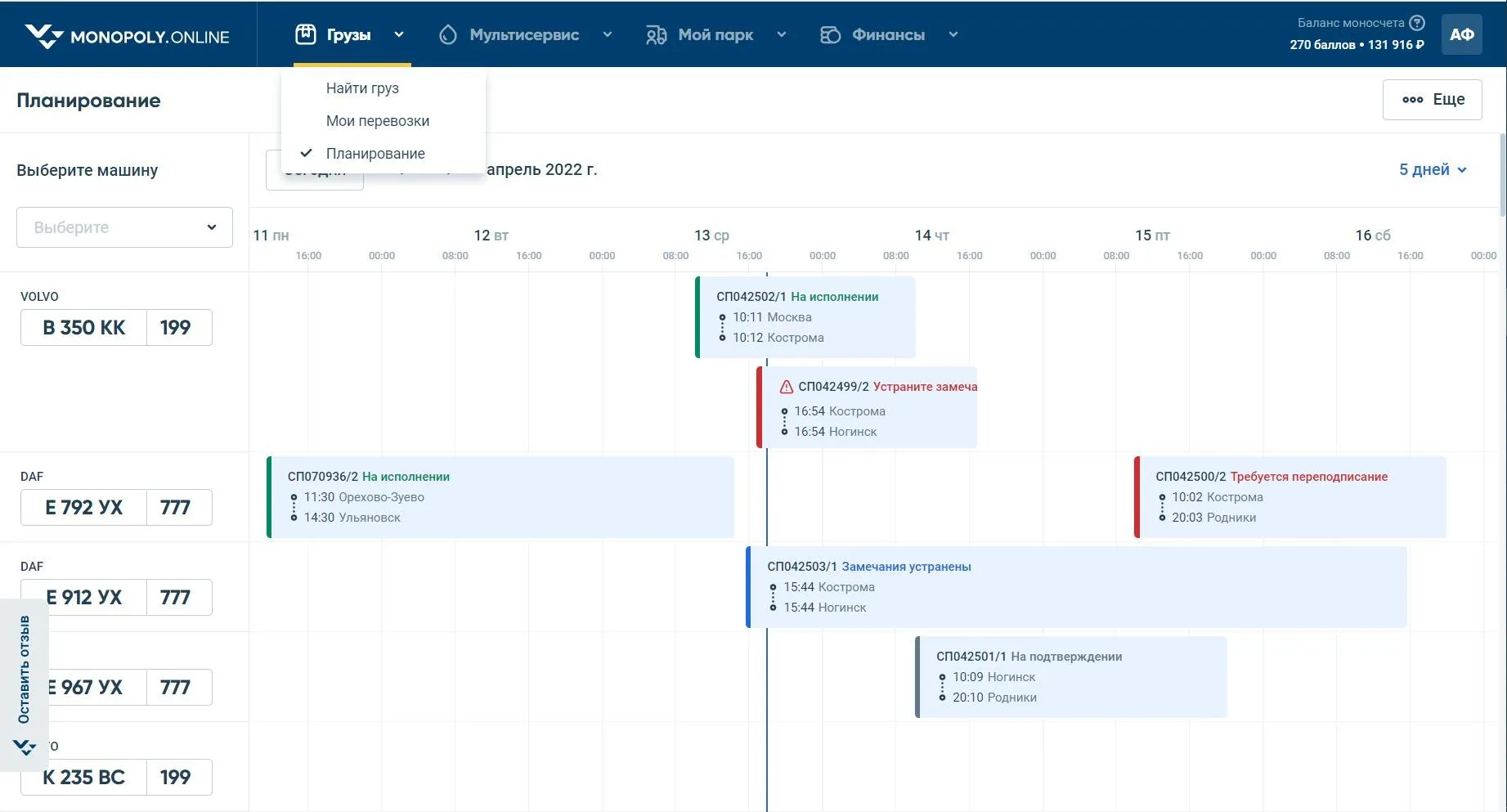
Monopoly is a service for organizing freight transportation that connects cargo owners with carriers, similar to taxi aggregators.
Analogues: Uber Freight (USA), Convoy (USA), Sennder (EU)
Career path
I looked into e-docs management and decided that the most important thing was to grow the platform’s user base, get users to use it regularly, and involve carriers in using online tools to manage their orders on their own.
After that, e-docs management was planned as a feature in the TMS.
Results
- Delivered TMS MVP in 1.5 months (planned 6), first in Russia for small carriers
- 50% of the test group showed activity, and 25% became regular users in the first month
- 60% of new shipments from active users sourced via TMS
- 30% of users added external orders, expanding dataset and improving route recommendations
- Enabled automated routing, tracking, document management, and multi-platform order imports
- Designed UX/UI for non-digital-savvy users
- Product paused due to shifting priorities after the war began
Career path
My first product role, where I gradually grew from working with a small RTB team to launching new products and managing several advertising platforms at the same time.
Results
- Increased RTB service operating profit from $7–8K to $12–15K per day through auction optimization, ML-driven features, anti-fraud improvements , and more
- Reduced RTB operational costs by 30–50% by optimizing internal workflows and building self-service tools for managers and tools for partner integrations.
- Relaunched publisher SSP, accelerating time-to-market 2–3x, boosting tag integration by 50%
- Built in-house White Label platform (Zeydoo, Trads.io, Notix, Propush.me), reducing new platform launch from 6 to 1–3 months
Career path
My background in sales and team leadership quickly led me from handling complaints, fraud cases, and complex customer issues to building a new product support team from scratch and leading it further.
Responsibilities
- Organized the work of the support team of the new product Avito.Delivery
- Managed and monitored KPIs
- Optimized the processes for handling calls and messages from users
Transition to Product Management
Working closely with both product support and product development led me to seek a new role focused on building and improving products, not just supporting them after launch.
Career path
Progressed from Junior Sales Consultant to Team Lead, managing several retail locations, each with 3–5 assigned employees and 15–20 retail partners, such as mobile phone stores.
Responsibilities
- Training, mentoring and management of my own sales team
- Managed sales in partner stores
- Launch of sales in new cities
Product
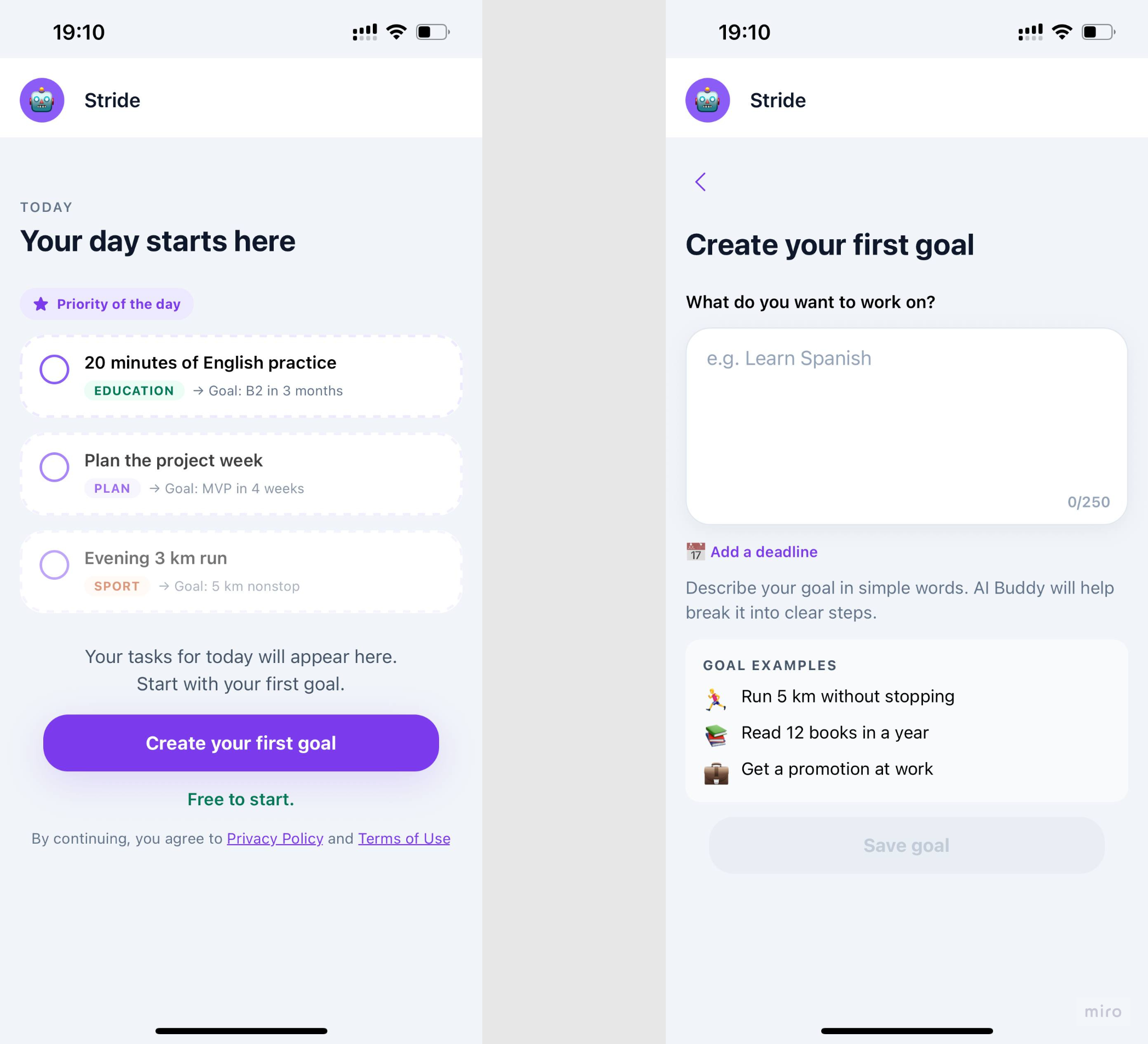
Follow is a mobile app that turns vague personal goals into structured plans, daily actions, and visible progress.
It analyzes goals, breaks them into realistic steps, helps plan the work, and adapts recommendations to the user’s pace, capacity, and workload across active goals.
The main value is reducing planning routine and the uncertainty of what to do next.
For What
I built Follow as a solo product to get full-cycle experience in mobile apps, product launch, positioning, marketing, and technical decision-making.
It also became a practical experiment in using AI as a productivity multiplier across product, design, development, operations, and documentation.
Result
Moved from concept validation and several failed prototypes to MVP and version 1.0.
The current product includes onboarding, goal creation, AI-based goal analysis, planning logic, adaptive recommendations, progress tracking, and an admin layer.
Version 1.0 is prepared for App Store moderation.
How
Built solo with React Native, Expo, FastAPI, PostgreSQL, SQLAlchemy, and JWT auth.
AI is integrated into goal analysis, planning, strategy generation, step maintenance, and daily recommendations.
Neural networks were used across research, prototyping, UX, copy, architecture, coding, debugging, DevOps, and documentation.
Follow web-site
Product
A small app lab for mini-apps, casual games, and weird digital experiments.
Simple ideas, fast launches, cheap tests, and products small enough to ship without a committee.
For What
I use it to learn game mechanics, mobile publishing, monetization, and product areas I had not touched deeply before.
Also: to test how far one person can go with AI tools, vibe coding, and enough stubbornness.
Result
A pipeline of lightweight consumer experiments: mini-games, utility apps, and small entertainment products.
Some are for learning, some are for testing mechanics, and some are attempts to make extra money.
How
Solo mode: idea, product, UX, code, copy, ops, and launch.
Small scope, fast builds, AI-assisted development, and no overbuilt nonsense.
Product
An alert tuning simulator for event-based monitoring across partners, clients, and integrations.
It helps teams test alert rules on historical data instead of relying on one-size-fits-all thresholds for clicks, purchases, ad views, conversions, and other events.
For What
I built it to solve a common monitoring problem: generic alerts either miss real incidents or create too much noise.
The tool lets managers calibrate alert rules themselves without constant analyst support or manual dashboard digging.
Result
Reduced alert noise, lowered analyst dependency, and improved detection of revenue-impacting incidents.
The simulator is used by several companies I worked with as a freelancer to tune partner-specific monitoring and avoid alert fatigue.
How
The simulator replays historical event data and shows which alerts would have triggered under selected rules.
Users can adjust thresholds, event types, time windows, comparison periods, averages, medians, anomaly exclusions, and partner-specific settings before applying rules to live monitoring.